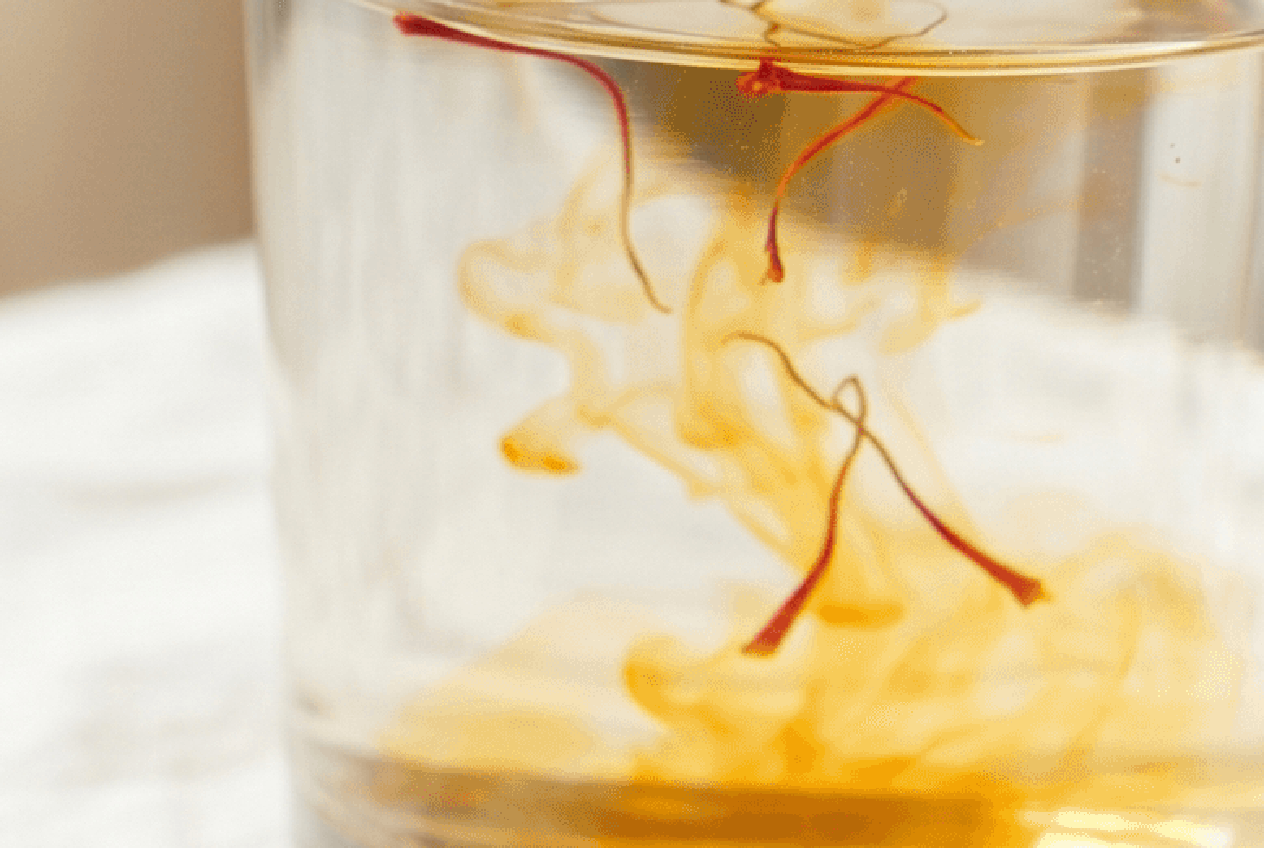
Drop a few threads into warm water and watch what happens. The gold does not sit still — it unspools, curls, and fills the glass. What you are watching is crocin leaving the thread, the same carotenoid pigment that makes a bowl of kesar doodh glow. Carotenoids are also, as it happens, the family of compounds the retina is built to use.
That is roughly the thought an Italian research group had in the late 2000s, and it led to one of the more surprising lines of nutrition research of the last twenty years.
What was actually tested
In 2010, Falsini and colleagues published a small randomised, placebo-controlled crossover trial in Investigative Ophthalmology & Visual Science: twenty-five patients with early age-related macular degeneration took 20 mg of saffron a day for three months, then swapped to placebo. They measured retinal function directly with a focal electroretinogram rather than asking people how they felt. Retinal flicker sensitivity improved on saffron and did not on placebo.
A follow-up by Piccardi and colleagues in 2012 kept twenty-nine patients on 20 mg a day for around fourteen months. The improvement did not fade — it appeared within three months and held, and mean visual acuity improved by about two Snellen lines from baseline. A related 2013 paper by Marangoni's group found the benefit was not confined to people with a particular genetic risk profile: it showed up regardless of the CFH and ARMS2 variants that shape who gets macular degeneration in the first place.
The largest and most rigorous test came in 2018, when Broadhead and colleagues in Australia ran a randomised, double-blind, placebo-controlled crossover trial in a hundred adults. The effect was real but modest — best-corrected visual acuity improved by 0.69 letters and retinal response latency shortened slightly. What made that result interesting was the group already taking AREDS supplements, the standard nutritional protocol for macular degeneration: saffron improved their vision too, which suggests it is doing something those formulations do not.
Where the evidence stops
Honestly, and this matters. These are small studies. The 2024 twelve-month extension of the Australian trial found retinal responses still improved in the central rings, but visual acuity was 1.6 letters worse than at the start — the authors suspect cataract progression, which saffron was never going to hold back. Trials have used 20 mg, 30 mg and 50 mg a day and there is no settled answer on which is right. Nobody has yet run the large, long, multi-centre trial that would turn this from a promising signal into clinical practice.
So the accurate summary is this: in early macular degeneration, a small daily dose of saffron has repeatedly been associated with measurable improvements in how the retina responds to light, across several independent groups, with no serious side effects reported. That is genuinely unusual for a food. It is not a treatment, it does not replace an ophthalmologist, and if your vision is changing you should see one.
The part that is ours to get right
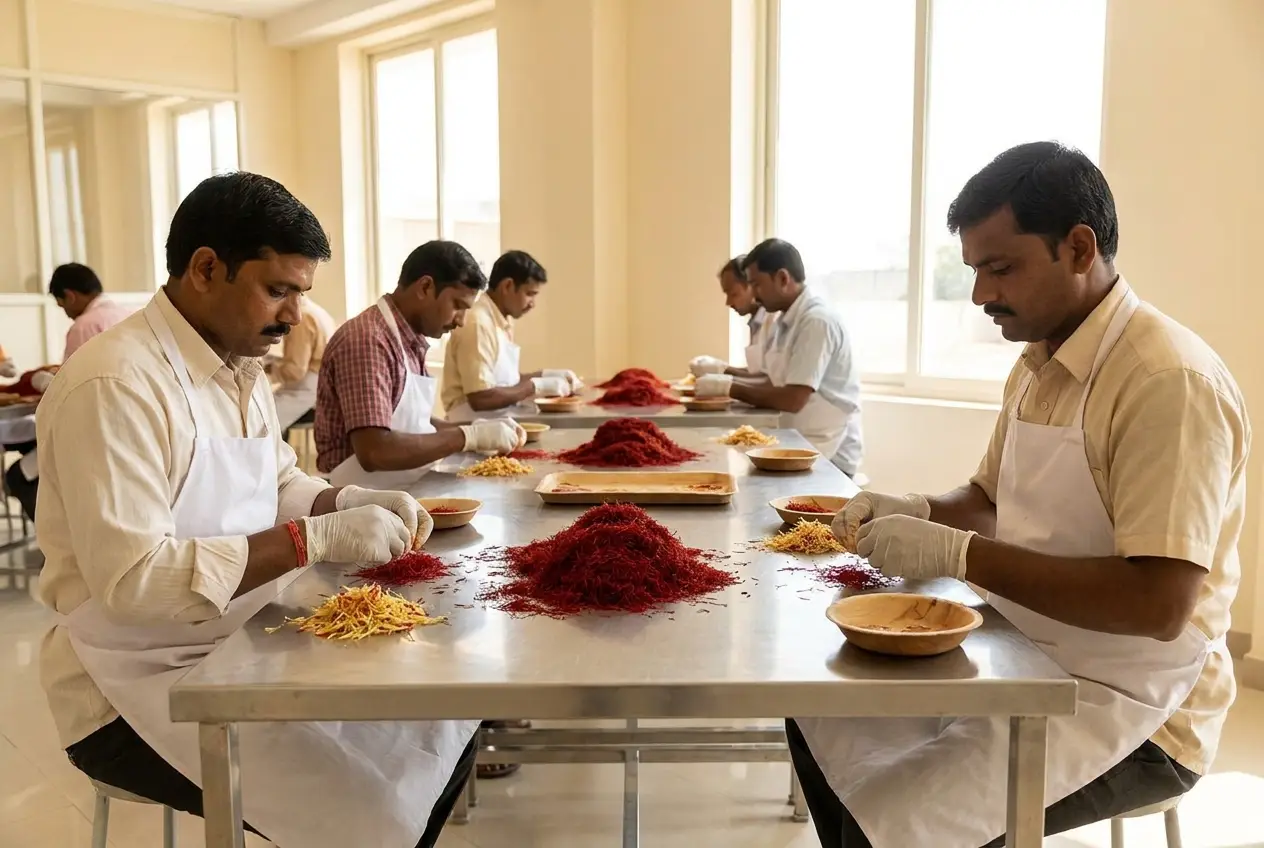
Every one of these trials used real saffron, standardised for its crocin content. Adulterated saffron — dyed corn silk, safflower petals, threads bulked with colouring — carries none of the chemistry the research is about. Which is a roundabout way of saying that the science is only ever as good as the spice, and the spice is the part we can promise.
The research behind this
- Falsini B et al. Influence of saffron supplementation on retinal flicker sensitivity in early age-related macular degeneration. Investigative Ophthalmology & Visual Science, 2010.
- Piccardi M et al. A longitudinal follow-up study of saffron supplementation in early age-related macular degeneration: sustained benefits to central retinal function. Evidence-Based Complementary and Alternative Medicine, 2012.
- Marangoni D et al. Functional effect of saffron supplementation and risk genotypes in early age-related macular degeneration. Journal of Translational Medicine, 2013.
- Broadhead GK et al. Saffron therapy for the treatment of mild/moderate age-related macular degeneration: a randomised clinical trial. Graefe's Archive for Clinical and Experimental Ophthalmology, 2018.
- Broadhead GK et al. Saffron therapy for the ongoing treatment of age-related macular degeneration. BMJ Open Ophthalmology, 2024.
- Sepahi S et al. Effects of Crocin on Diabetic Maculopathy: A Placebo-Controlled Randomized Clinical Trial. American Journal of Ophthalmology, 2018.
- Piccardi M et al. Antioxidant Saffron and Central Retinal Function in ABCA4-Related Stargardt Macular Dystrophy. Nutrients, 2019.
- Sepahi S et al. Pharmacological Effects of Saffron and its Constituents in Ocular Disorders from in vitro Studies to Clinical Trials: A Systematic Review. Current Neuropharmacology, 2021.
- Shamabadi A et al. Crocus sativus (saffron) and age-related macular degeneration. Medical Hypothesis, Discovery & Innovation in Ophthalmology, 2024.
- Lashay A et al. Short-term outcomes of saffron supplementation in patients with age-related macular degeneration. Medical Hypothesis, Discovery and Innovation in Ophthalmology, 2016.
This article summarises published research. It is not medical advice, and saffron is a food, not a treatment for any eye condition.